
Joint Pain Slowing You Down? Here Are Non-Surgical Treatment Options
April 26, 2026
Why Your Shoulder Pain Isn’t Going Away (And What You Can Do About It)
April 26, 2026
Stiff Neck and Headaches? Here’s What Your Body Is Telling You
Waking up with a stiff neck and a headache that lingers through the afternoon is miserable on its own. The part that makes it harder is when it keeps happening. You stretch, take something for the pain, and within a few days you are back in the same place, which is usually the point where most people start looking for a trusted chiropractor service.
That pattern is not coincidence. When neck stiffness and headaches consistently arrive together, they are typically coming from the same source: the cervical spine.
At our clinic, we see this combination often, and the underlying cause is almost always a treatable structural problem. Call us at (321) 234-0124 or book your first visit for $39.
What the Cervical Spine Has to Do With Your Headaches
Most people assume headaches originate in the head. A large portion of recurring headaches do not. Headaches that begin at the base of the skull and spread forward toward the forehead or behind the eyes often come directly from the cervical spine.
The cervical spine houses the nerve roots that supply sensation to the scalp, the face, and the surrounding musculature. When the vertebrae in the neck are misaligned, when a disc is compressed, or when the surrounding muscles are chronically tight from poor posture or injury, those nerve roots become irritated. That irritation creates a headache that originates in the neck but registers as head pain.
These are called cervicogenic headaches, meaning the cervical spine is the source. They almost always accompany neck stiffness because both symptoms are driven by the same underlying dysfunction. Treating the headache without addressing what the cervical spine is doing produces only temporary relief.
Why the Stiffness Keeps Coming Back
Neck stiffness that does not fully resolve between episodes means the structural problem causing it has not been corrected. The most common reasons:
Vertebral Misalignment
When a vertebra in the cervical spine shifts slightly out of its normal position, it restricts normal joint movement and irritates the nerves in the area. The surrounding muscles often tighten as a protective response. That tightening is what registers as stiffness, and it will keep returning until the alignment is corrected.
A vertebral misalignment is also called a subluxation: a vertebra that has shifted out of normal alignment, reducing proper joint function and affecting the nervous system in the surrounding segment.
Disc Compression
The discs between the cervical vertebrae maintain the spacing that nerve roots require. When a disc is compressed, dehydrated, or has begun to herniate, that space narrows. The result is reduced joint mobility and nerve irritation that feeds directly into the headache pattern most patients describe.
Postural Strain
Sitting at a desk or looking at a screen for hours gradually shifts the head forward relative to the shoulders. Each inch of forward head position increases compressive force on the cervical spine. Over time, this produces joint dysfunction, chronically tight posterior neck muscles, and the exact conditions that generate both stiffness and cervicogenic headaches.
Soft Tissue Restrictions
The muscles and connective tissue of the cervical spine can develop trigger points and adhesions from repetitive strain, prior injury, or prolonged tension. A trigger point is a tight, irritable knot within a muscle that refers pain to a nearby area. In the neck, these refer pain to the base of the skull, the temples, and behind the eyes.
How We Evaluate and Treat This Pattern
Every treatment plan we build starts from the evaluation. Dr. Michael Bowerman and Dr. Carlos Gomez, both Doctors of Chiropractic trained at Palmer College of Chiropractic (established in 1897), assess the full cervical spine before recommending any therapy. Dr. Bowerman is a member of the American Chiropractic Association. Dr. Gomez holds membership in the Florida Chiropractic Association and the Florida Chiropractic Society.
Depending on what the evaluation reveals, care may include:
Chiropractic Adjustments
A controlled, targeted adjustment to a restricted cervical vertebra restores normal joint movement, reduces nerve irritation, and removes the mechanical source of both the stiffness and the headache. For patients with cervicogenic headaches, upper cervical adjustments are frequently the most direct and effective intervention.
Intersegmental Traction
A table-based therapy using rollers that travel along the cervical and thoracic spine to gently mobilize each spinal segment, improve disc hydration, and increase flexibility. Patients with significant cervical stiffness often find this restores movement before deeper treatment begins.
Electrical Muscle Stimulation
Low-level electrical impulses delivered to the tight cervical and upper trapezius musculature reduce spasm and decrease pain before an adjustment. Using EMS first relaxes the surrounding tissue and makes structural treatment more effective.
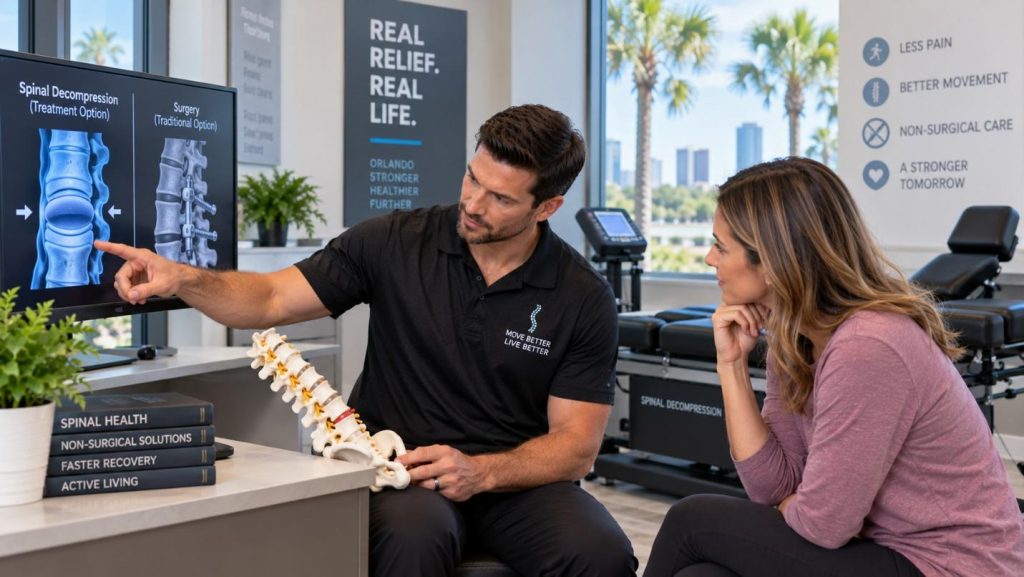
Spinal Decompression Therapy
When cervical disc compression is identified as a contributing factor, non-surgical spinal decompression creates controlled negative pressure to relieve pressure on the compressed disc and the nerve root it is irritating. This is particularly relevant when the headache pattern includes radiation into the shoulder or arm.
Exercise Rehabilitation
Rebuilding the deep cervical flexors and the postural muscles of the upper back reduces the compressive load on the cervical spine during daily activity. Without this, even patients who respond well to adjustments often find themselves cycling back to the same problem.
What to Expect at Your First Appointment
Your first visit includes a full evaluation covering your symptom history, a physical assessment of the cervical spine, and a thorough discussion of a recommended treatment plan. We take time to explain the reasoning behind every therapy before anything begins. Patients do not leave their first visit without understanding what is happening and why.No referral is needed. Patient intake forms are available online ahead of your appointment.
Related topics: